How Do You Convert A Treasured Heirloom Desktop Into A Sit Stand Workstation Without Damaging It?
A cherished solid wood top can become a genuine sit-stand desk, but only if the panel, the frame, and the mounting method are chosen with care. Here is how to judge the piece and do the work reversibly.
Deciding whether the top is even a candidate
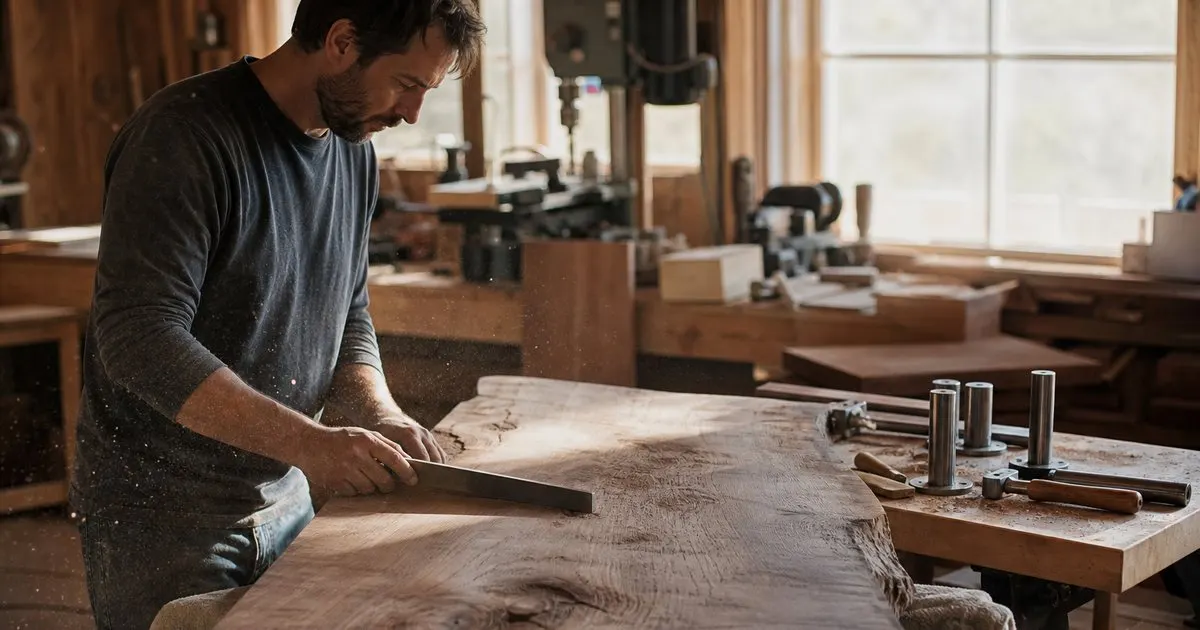
Not every beautiful top belongs on a lift base. The first question is what the panel actually is. A solid hardwood slab, a well built frame and panel top, or a thick engineered core under a good veneer can all work. A thin veneer over particleboard, a top that already sags across its span, or a piece with documented history and original finish is a different matter. Turn the top over and read the underside: look for continuous grain that matches the face, breadboard ends, corner blocks, and old screw holes. Measure thickness at several points and check flatness with a long straightedge, because a slab that rocks on a level floor will not sit true on a rigid steel frame. Related: How Do You Care For A Solid Wood Sit Stand Desk Top Over Decades?
Weight and geometry decide the rest. A large solid walnut or white oak top typically weighs far more than most people expect, and that mass has to be carried by the frame and lifted thousands of times over the life of the desk. Look closely at what lives underneath as well: an apron, a pedestal of drawers, a modesty panel, or a carved skirt will usually collide with lift columns and crossbars. Original bases can rarely be reused, so decide in advance whether you are willing to separate the top permanently from the piece it came with. If the answer is no, a sit-stand conversion is not the right project for this particular desk. Related: How Do You Choose The Right Size And Height Range For A Standing Desk?
Keep reading: What Makes An Executive Sit Stand Desk Worth A Premium Investment?, How Do You Choose The Right Size And Height Range For A Standing Desk?, Which Materials And Finishes Elevate A Luxury Executive Desk Above The Rest?. See how Ergonestr helps you a curated guide to the finest sit-stand and executive desks.
Matching the base to the weight, span, and travel you need
Rated capacity is the headline number, but the useful rule is to leave generous margin. Add the weight of the top to everything that will live on it: monitors and arms, a heavy lamp, books, a printer, and the load of someone leaning hard on one corner. Choose a frame whose rating comfortably exceeds that total rather than one you will run close to its limit, since motors and gearboxes working near capacity typically run hotter, sound louder, and wear sooner. Three-stage columns generally offer more travel and a lower minimum height than two-stage columns, and that lower minimum matters here for a reason many buyers overlook.
The reason is stack height. Your seated height is the frame at its lowest position plus the thickness of the top, so a two and a half inch slab on a frame with a tall minimum can leave a shorter user sitting too high with no way to correct it. Do that arithmetic before ordering anything. Span matters too. A wide top needs a long crossbar, wider foot placement, or a third column, otherwise the middle flexes and the assembly feels lively at standing height. Ask the frame maker for the maximum recommended top width, depth, and weight for the exact model you are considering rather than assuming a generic figure applies. Related: What Should You Know About Motor Quality In A High End Sit Stand Desk?
Mounting methods that respect wood movement and stay reversible
Solid wood expands and contracts across the grain with the seasons while a steel frame does not move at all. Fastening a wide slab tightly to rigid rails at every point is how tops crack. The traditional answers still work: elongated slots in the frame rails, figure eight fasteners, tabletop clips set into a shallow groove, or a hardwood subframe that carries the lift frame and is itself attached to the top with slotted hardware. Fasteners should run up through the frame into the underside only, sized with a depth stop so nothing can telegraph through or break the show face.
Reversibility protects value. Drill pilot holes rather than driving screws cold into dense hardwood, use pan head screws with washers wherever a slot needs to let the wood travel, and never glue or tape a top to a base. Keep the original hardware, fittings, and any removed apron labeled in a box so the piece can be returned to something close to its original state. If the top has a finished underside or visible joinery you would rather not perforate, a clamped cleat system or a full carrier panel that cradles the top can spread the load without putting a single new hole in the original material.
When to bring in a professional, and when to leave the piece alone
Some conversions belong with a cabinetmaker or furniture restorer from the first day. A slab that needs flattening, a top with an old split, a veneered antique, or any piece with real provenance should be assessed by someone who works on furniture for a living, because the cost of getting it wrong is the piece itself. A good shop can also build a discreet hardwood subframe, plug and color old holes, tidy a rough underside, and hand back something that looks intentional rather than improvised. Ask to see photographs of similar work before you commit.
It is equally sensible to decide not to convert at all. If the plan adds up to a custom subframe, a high capacity frame, freight, and a day of skilled labor, compare that total honestly against a purpose-built executive sit-stand desk in the same species, and consider keeping the heirloom as a writing table or credenza in the same room. The best outcome is often two pieces used well rather than one compromised piece that neither raises smoothly nor reads as the antique it used to be. Related: What Makes An Executive Sit Stand Desk Worth A Premium Investment?
- Read the underside first: solid slabs and well built engineered tops convert cleanly, thin veneer over particleboard does not.
- Add the top weight to everything you load on it, then pick a frame rated comfortably above that total.
- Seated height equals frame minimum plus top thickness, so check that arithmetic before committing to a thick slab.
- Use slotted hardware or a subframe so the wood can move, and keep every modification fully reversible.

Julien Jimenez
Julien Jimenez is an independent software builder based in Paris. He designs, ships, and operates focused SaaS products for small businesses and independent professionals. Read the full author page.
A Desk Worthy of the Work
A curated guide to the finest sit-stand and executive desks. Ergonestr is built to help you put this into practice.
Find your deskMore from the Ergonestr blog

What Makes An Executive Sit Stand Desk Worth A Premium Investment?

How Do You Choose The Right Size And Height Range For A Standing Desk?
Which Materials And Finishes Elevate A Luxury Executive Desk Above The Rest?
Get the complete luxury sit-stand and executive desks guide
Our full buying guide, the price guide, and new research as we publish it. One email, no spam, unsubscribe any time.